
Our Products
Bitumen Viscosity Grade
Another prevalent means of grading bitumen is the viscosity grading system, which divides bitumen into four categories: VG 10, VG 20, VG 30, and VG 40.
Bitumen VG-10
Although bitumen VG10 and bitumen pen 80/100 have certain similarities, their performance is not the same. In spite of its greater tolerance to temperature variations, particularly in cold climates, VG10 outperforms bitumen 80/100 in road construction.
Bitumen VG-30
Bitumen VG30 looks identical to bitumen 60/70, but the two grades have different capabilities. First and foremost, high-quality vacuum bottoms are utilized in the manufacturing of VG30 bitumen. Second, VG 30 bitumen is proved to perform more efficiently than pen grade bitumen 60/70 since it is more thoroughly tested.
Bitumen VG-40
Refineries create VG 40 bitumen, which is used in locations with higher temperatures. Because of its higher viscosity, this grade of bitumen significantly enhances a pavement’s resistance to difficulties associated with higher temperatures and strong traffic loads.
Bitumen Penetration Grade
Bitumen penetration grades are best suited for paving roads and other surfaces. They are named after the system of grading. We utilize a penetrometer to classify bitumen after production. The equipment contains a standard needle that penetrates the bitumen sample and allows us to measure its hardness level. If the needle easily enters the bitumen sample in a particular period, the bitumen is softer, whereas if it struggles to enter the sample, it is harder. The softest grade of bitumen penetration is 100/120, while the harshest grade is 30/40. Other classes of bitumen penetration include 40/50, 50/70, 60/70, 80/100, and 85/100.
Bitumen penetration 60/70
The standard grade of bitumen that works effectively in the majority of road projects is bitumen penetration 60/70. This grade of bitumen is the best option for aggregate coating and adherence across a wide temperature range (-22 to +76). Although this grade of bitumen undergoes less processing than other grades, its quality is adequate. We conduct a number of tests on bitumen 60/70 immediately following manufacture to guarantee that it can withstand varying temperatures. These tests include penetration, softening point, ductility, and flash point.
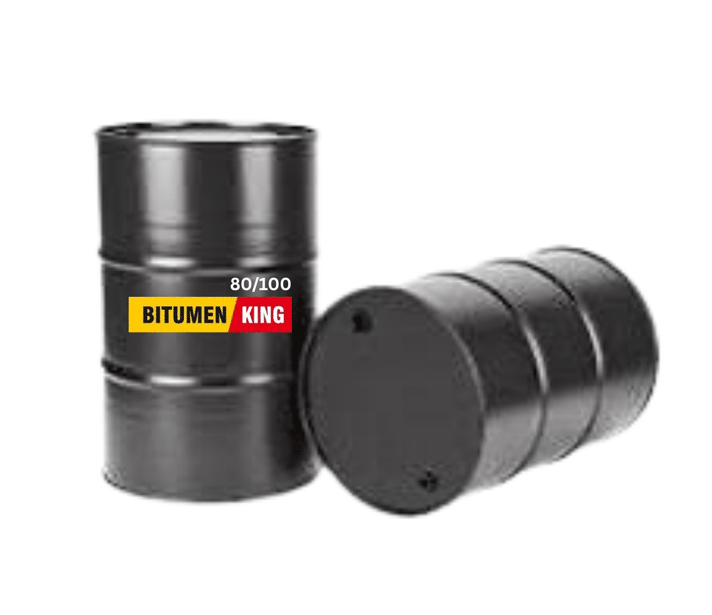
Bitumen Penetration 80/100
Bitumen 80/100 is another popular penetration grade. Because of its hardness, this bitumen is perfect for paving roads in Central African and Indian nations. The ability of bitumen pen 80/100 to significantly lower road construction costs contributes to its appeal. This type of bitumen is reasonably priced, which helps traders boost their profits and end users prolong the roads’ service life.
BITUMEN EMULSION
Rapid Setting Emulsion RS 1
Road construction and repair, as well as a variety of other uses including patching and grouting, are all accomplished with rapid setting emulsion. The product known as RS1 is made from bitumen that has been emulsified to disseminate it into water in the form of tiny globules. The latter prevents the bitumen and water from breaking under typical storage settings by reducing the interfacial stress between them.
Medium Setting (MS) Emulsion
Bitumen emulsion and coarse aggregate are premixed using a medium setting type of emulsion. It is a water-based bitumen emulsion that has been carefully formulated to have a moderate viscosity and setting time. It is the perfect product for premixing applications because of its medium setting time range. At room temperature, it is a free-flowing liquid with a chocolate brown tone.
Slow Setting Emulsion SS1
This kind of emulsion slows down the evaporation of water by using a particular kind of emulsifier. Emulsifiers of this kind are rather stable. SS1 is specially designed oil-based bitumen emulsion with low viscosity, extended setting time and stability with cement that makes it an ideal product for prime coat application. At room temperature, it is a free-flowing liquid with a black coloring .